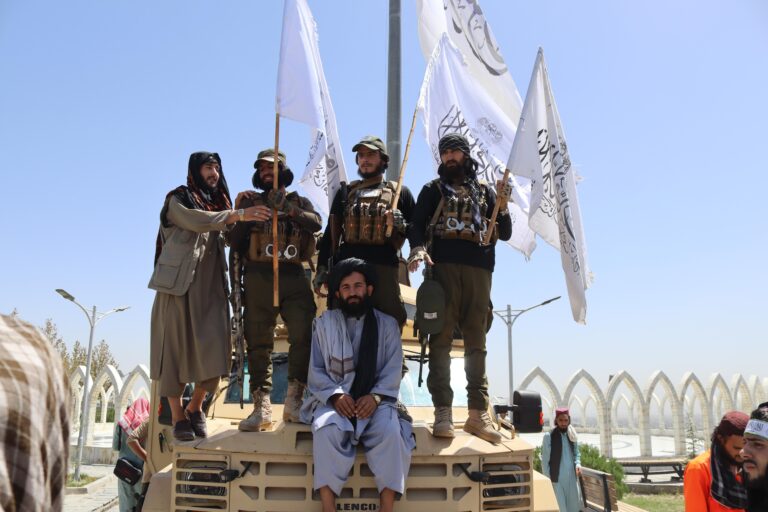
Five years after the Taliban swept back to power in Kabul, Afghanistan presents a paradox: a government that has survived, an armed resistance that has persisted, and a country whose problems remain far from resolved. The opposition is fragmented but active; relations with Pakistan have deteriorated into a dangerous security confrontation; and economic growth has done little to ease widespread hardship. As the Taliban enter their sixth year in power, the question is no longer simply who controls Afghanistan, but how sustainable that control will prove amid mounting internal and regional pressures.
Resistance without unity
Five years after the Taliban’s return, armed resistance persists, but its reach should not be confused with its capacity to challenge the government. The National Resistance Front (NRF), led by Ahmad Massoud, remains the best-known opposition movement, drawing on the legacy of Massoud’s father, former Northern Alliance commander Ahmad Shah Massoud, and claiming attacks across several provinces.
The Afghanistan Freedom Front (AFF), associated with former Afghan army chief Yasin Zia, has also claimed operations against Taliban forces. Both movements emerged from the collapse of the former republic, relying heavily on former security personnel and networks. The Afghanistan United Front (AUF), led by former special forces commander Sami Sadat, represents another attempt to organise political and military opposition from exile.
The limits are evident in the data. According to the European Union Agency for Asylum’s February 2026 report, the UN verified 277 attacks by armed opposition groups between August 2024 and July 2025, including 165 attributed to the NRF and 55 to the AFF. Yet no resistance group had established sustained territorial control.
A notable exception came on 17 July 2026, when the newly emerged Homeland Soldiers Front, also known as Sepahiyan-e Mihan, briefly seized the Yaftal-e Sufla district headquarters in Badakhshan, disarmed Taliban personnel and withdrew before reinforcements arrived. The Taliban confirmed the district centre had been attacked and said reinforcements were dispatched.
The episode exposed a local security vulnerability, not a nationwide shift in power. The NRF, AFF, AUF and smaller fronts remain divided over leadership and political strategy, with no unified command or demonstrated ability to hold territory. Afghanistan’s armed opposition has multiplied, but it has yet to consolidate into a credible alternative to Taliban rule.
Pakistan: From expectations to confrontation
In 2021, Pakistan expected the Taliban’s return to power in Kabul to improve security along its western frontier. Instead, relations have deteriorated over the Tehreek-e-Taliban Pakistan (TTP), a militant organisation which seeks to overthrow the Pakistani state and establish its own system of Islamic rule; it has conducted hundreds of attacks against Pakistani security forces and other targets.
Islamabad accuses Kabul of allowing the TTP and other militant groups to operate from Afghan territory; the Taliban deny responsibility for attacks inside Pakistan. A UN Security Council-mandated monitoring report published in August 2026 said continued Taliban support had contributed to more frequent and lethal TTP attacks, while noting some initial efforts by Kabul to restrain the group.
The crisis has escalated beyond diplomatic exchanges. Pakistan conducted fresh air strikes inside Afghanistan in September and October 2026, while border clashes and competing allegations of civilian and military casualties continued. On 24 October, Pakistan again demanded verifiable action against militants, underscoring the absence of a durable security agreement.
The economic fallout is substantial. By August 2026, major crossings had been largely closed for more than 300 days, disrupting trade through Torkham and Chaman. The World Bank reported that shipments were being redirected through Central Asia and other routes, increasing transport costs and delivery times.
Mass returns of Afghans from Pakistan and Iran have added pressure on Afghanistan’s employment market and public services. The dispute has consequently become more than a counterterrorism problem: it now links border security, civilian protection, migration and regional commerce, with neither government having secured a lasting settlement
An economy under pressure
Afghanistan’s economic recovery remains fragile: output is growing, but living standards continue to deteriorate. The World Bank’s May 2026 assessment estimated GDP growth of 4.8% in 2025, yet GDP per capita fell by 5.6% as population growth and the return of 3.7 million Afghans outpaced economic expansion. A separate UNDP assessment found that 28 million people, 74% of the population, could not meet their basic needs that year. More than 80% of households were in debt, while drought, declining aid and a widening trade deficit deepened the strain.
Domestic revenue collection reached 19.8% of GDP in 2025, according to the World Bank, but falling external grants have constrained public investment. Restrictions on women’s education and employment further weaken the recovery: UNICEF reported in August 2026 that more than 2.6 million girls had been denied secondary education since 2021. The challenge is not merely one of generating growth, but of creating jobs and restoring the human capital needed to sustain it.
Diplomatic engagement without recognition
Afghanistan’s diplomatic isolation has eased only partially. Russia became the first country to formally recognise the Taliban government in July 2025, while China, Iran, Pakistan and several Central Asian states have maintained varying degrees of diplomatic and commercial engagement. Yet, Moscow’s decision did not trigger a broader wave of recognition.
The principal obstacles remain the exclusion of women from education and much of public life, the absence of representative political institutions, human-rights concerns and regional fears over militant groups operating from Afghan territory. In August 2026, UNICEF highlighted the scale of educational exclusion, while the UN continued to warn that restrictions on women undermine Afghanistan’s economic development and international reintegration.
Regional governments nevertheless have practical reasons to engage with Kabul: China prioritises security and investment, Iran faces migration and border pressures, and Central Asian states seek stability and trade connectivity. The result is a distinction between maintaining working relations with the authorities and formally accepting their government. The Taliban seek recognition, investment and greater access to international finance; foreign governments continue to demand security assurances and changes in domestic policy.
ISKP: A separate threat to Taliban security
The Islamic State Khorasan Province (ISKP), the regional affiliate of the Islamic State, remains a threat to Afghanistan despite a decline in attacks since its 2022 peak. Unlike the NRF and AFF, it seeks an extremist order of its own and considers the Taliban an ideological enemy.
The UN monitoring team estimated ISKP’s strength at around 2,000 in 2025, with decentralised cells operating particularly in northern and north-eastern Afghanistan. Taliban raids have weakened its networks, but not eliminated its ability to strike.
On 19 January 2026, an ISKP-claimed suicide bombing at a Chinese restaurant in Kabul killed seven people, including one Chinese national, and injured at least 14. The attack highlighted the threat to civilians and Chinese interests as Beijing explores economic opportunities in Afghanistan.
In conclusion, five years after their return to power, the Taliban have consolidated political and territorial control without securing lasting stability. Fragmented resistance groups remain unable to mount a credible challenge to their rule, but their continued activity exposes persistent security vulnerabilities. Relations with Pakistan have deteriorated into an increasingly costly confrontation, while ISKP remains a threat to domestic security and regional interests. Economic growth has failed to translate into improved living standards, and diplomatic engagement has yet to overcome the barriers to broader international recognition.
The Taliban’s central challenge is no longer simply maintaining power, but demonstrating that their rule can deliver security, economic recovery and effective governance. Without progress in addressing militant activity, strained relations with neighbouring states, restrictions on women and political exclusion, Afghanistan risks remaining caught between entrenched domestic pressures and regional instability. The durability of Taliban rule may be established, but its long-term sustainability remains uncertain.